For the previous installment, see Part 1.
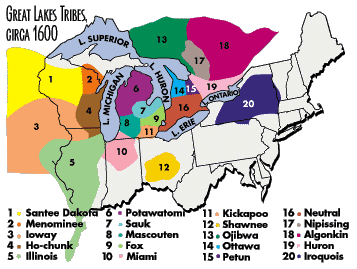
In the early 19th century, the now established Three Fires tribes faced a European invasion when in 1821, the Treaty of Chicago ceded the entire region south of the Grand River to the United States. Baptist missionaries built in the villages on the west bank of the Grand River. In this same year, 1827, the shrewd Louis Campau set up shop, eventually purchasing 72 acres of land where downtown stands today - for $90. A number of his relatives settled in the area and also bought land. For a time the language spoken “downtown,” then, was not an Anishinabek dialect, nor English, but French.
In the early 19th century, the now established Three Fires tribes faced a European invasion when in 1821, the Treaty of Chicago ceded the entire region south of the Grand River to the United States. Baptist missionaries built in the villages on the west bank of the Grand River. In this same year, 1827, the shrewd Louis Campau set up shop, eventually purchasing 72 acres of land where downtown stands today - for $90. A number of his relatives settled in the area and also bought land. For a time the language spoken “downtown,” then, was not an Anishinabek dialect, nor English, but French.
Campau, Lucius Lyon, and others prospered through trade and the buying and selling of city lots. The downtown developed, and the people of the Three Fires were slowly pushed out or left. Louis Campau lost a great deal of money in land speculation when the land boom's bubble burst. He had signed a surety bond for the goods in his brother Toussaint’s store, and did not have the money to cover the bills when it failed. Campau was forced to sign over much of his property until all these debts could be sorted out. And there went the neighborhood again. In 1838 the City of Grand Rapids was officially incorporated.
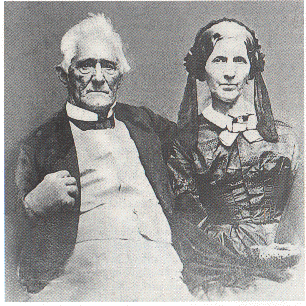
Campau’s entrepreneurial success, his energetic wheeling and dealing, and the displacement of the native peoples who had lived in villages here undoubtedly caused friction and hard feelings over time, but he remained on good terms with Chief Noonday and had many Indian friends all his life. Campau could be generous to a fault, and all of the city was welcome first in his log house, and then in the mansion he built on the southwest corner of Fulton and Gay.
With city incorporation, more settlers arriving, and a more formal city emerging, some of the trappings of East Coast civilization emerged. Chages at first were small and slow. Campau renamed the Indian footpath along the river Monroe Street after President Monroe. Other trails leading to Campau's trading post were eventually called by recognizable names: Butterworth, Kalamazoo, Lake Drive, Plainfield, and Walker. Joel Guild built the first frame house with lumber sawed at an Indian mill in 1833. That Christmas in a letter to relatives, Guild wrote that the area was "settling very fast with respectable citizens." It was much easier for settlers to travel to Michigan and all parts west after the Erie Canal was complete in 1825. Guild mailed that letter from one of the area's two post offices.
Major earthworks projects reshaped the river and removed Prospect Hill. Farms sprung up in all directions radiating from the village. The Lucius Lyon Salt Works opened in 1842, and the Granger & Ball gypsum mill began operation. John Ball's name appears first in the city's records in 1836, and when the census was first taken in 1845, there were 1,510 residents. By this time the village had shops, mills, factories, tanneries, public houses, smiths, and three doctors. The first Grand Rapids dentist, J.T. Collier, who advertised his services arrived in 1843.
The villagers in Grand Rapids began building more formal churches. The Congregational Church at the corner of Division and Monroe had a thousand-pound bell that tolled the hours; it was one of four local places of worship. When the first east-west stone-foundation bridge was build in 1845, the city was beginning to feel permanently settled. It had by-laws, a fire barn and fire engine, paid trustees, and board sidewalks. The times, they were a-changin'.
With city incorporation, more settlers arriving, and a more formal city emerging, some of the trappings of East Coast civilization emerged. Chages at first were small and slow. Campau renamed the Indian footpath along the river Monroe Street after President Monroe. Other trails leading to Campau's trading post were eventually called by recognizable names: Butterworth, Kalamazoo, Lake Drive, Plainfield, and Walker. Joel Guild built the first frame house with lumber sawed at an Indian mill in 1833. That Christmas in a letter to relatives, Guild wrote that the area was "settling very fast with respectable citizens." It was much easier for settlers to travel to Michigan and all parts west after the Erie Canal was complete in 1825. Guild mailed that letter from one of the area's two post offices.
Major earthworks projects reshaped the river and removed Prospect Hill. Farms sprung up in all directions radiating from the village. The Lucius Lyon Salt Works opened in 1842, and the Granger & Ball gypsum mill began operation. John Ball's name appears first in the city's records in 1836, and when the census was first taken in 1845, there were 1,510 residents. By this time the village had shops, mills, factories, tanneries, public houses, smiths, and three doctors. The first Grand Rapids dentist, J.T. Collier, who advertised his services arrived in 1843.
The villagers in Grand Rapids began building more formal churches. The Congregational Church at the corner of Division and Monroe had a thousand-pound bell that tolled the hours; it was one of four local places of worship. When the first east-west stone-foundation bridge was build in 1845, the city was beginning to feel permanently settled. It had by-laws, a fire barn and fire engine, paid trustees, and board sidewalks. The times, they were a-changin'.