Showing posts with label downtown. Show all posts

Friday, March 4, 2016

Will Grand Rapidians rely on the co-op option for downtown housing?

Grand Rapids has a very low vacancy rate for its rental housing. It has, in fact, the lowest vacancy rate in the nation -- 1.6 percent -- for a number of reasons. As a result of the housing meltdown and the Great Recession, many Americans have damaged credit and cannot qualify for a mortgage or, having lost their homes, do not want to invest in home ownership again. Also pushed into the renters’ market are young college graduates. A generation or two ago, young professionals would have been looking for houses to purchase, but now they are burdened with student loan debt or have relocated to find work and don’t want to explore longer-term options.

Grand Rapids also has a number of colleges, including Grand Valley State University and Grand Rapids Community College, both of which are located downtown where demand for housing is already high. Additionally, while Americans in the latter part of the 20th century were eager to move out of the city and to the suburbs, that trend is reversing as younger people struggle to afford cars and pay for gas on stagnant wages and with fewer job opportunities. As restaurants, breweries, farmer’s markets, sports and cultural venues continue to multiply in Grand Rapids, people of all ages want to be on hand to enjoy them.

Sunday, February 1, 2015

Housing developers bank on continued growth of downtown Grand Rapids

Last fall Forbes ranked Grand Rapids/Wyoming area the fifth fastest growing economy in the United States based on data gathered from Bureau of Economic Analysis study, and more recently The Brookings Institution rated the Grand Rapids economy 69th in the world for growth. Employment levels and GDP are up, and the continuing development happening within the city would seem to back this up.

A significant part of the recent development involves creating spaces for the knowledge workers moving to the city as a result of increased demand from the area’s manufacturing, healthcare, research, and educational sectors - specifically spaces for them to live.

While the trend during the mid-20th century was for successful people to move away from cities and out to the suburbs, the reverse is true now. Many Millennials are choosing to live a car-free lifestyle, and that can only be done downtown and only when the right amenities are available, which means that they have to be within walking or public transit distance of work, grocery stores, retail outlets, farmer’s markets, restaurants, museums, entertainment and sports venues, and schools. There have to be doctors, dentists, clinics, pharmacies, and hospitals nearby. And in this moment in Grand Rapids, that is possible, particularly downtown.
This is why there is so much interest in building new apartments, condos, and townhouses and revitalizing buildings that have sat empty for years. Demand is back.

On the north side of the city, 616 Development is planning to build a mixed-use space of apartments and retail on the Creston Corridor. Not far from there Franklin Partners is looking to develop the Display Pack building, an old furniture factory. The 375,000 square foot complex on Monroe could be transformed into 200 loft apartments - or possibly be used for office space. A little further towards downtown on Monroe, Orion Real Estate Solutions has tentative plans for a high-rise residential building on the riverfront, and the Belknap Lookout Brownstones development will offer high end condos and apartments across the highway from the Medical Mile, within easy walking distance for healthcare workers and their families.

Near Grand Valley’s downtown campus, Rockford Construction has plans to build two 5-story buildings housing 91 market rate apartments on the south side of W. Fulton St. This housing is to accommodate Grand Valley’s surging enrollment. And right downtown, a multi-story residential tower expansion of the B.O.B. will be moving forward after several previous postponements.

For those tempted to experience the downtown lifestyle in up-and-coming Grand Rapids, now is the time to explore the multiplying options.

Wednesday, August 27, 2014

Will downtown Grand Rapids get a major grocery store?

The explosion of housing development in downtown Grand Rapids has started a number of conversations about the general livability factor of the city and the lack of grocery availability in that area of the city. From data made available by JPMorgan Chase this summer, we know that downtown residents make 80 percent of their purchases outside the downtown area and that the Knapp's Corner Meijer and D&W is the most sought out location for grocery purchases.

Over the last decades a pattern of downtown working and suburban living emerged, but since the Butterworth/Blodgett merger and the development of the Medical Mile on Michigan, demand for downtown real estate has increased significantly, spurred on by increasing transportation costs as well. Suddenly the place to be is not longer in the suburbs, but in the city, and developers have been eager to build more housing that will appeal to people with professional jobs and incomes. Old factories and commercial buildings have been transformed into condos and apartments, and the city recently approved plans for a mixed-space development in the Belknap neighborhood, just north of the Medical Mile.

These changes have been controversial, with some calling them gentrification and others accusing the city of allowing the more well off citizens to push established residents out of key areas of the city. Other celebrate what they consider the significant improvements in dining choices, retail shopping, entertainment options, and public living.

What is not debated by either group is that downtown city living, despite its benefits, is more challenging because of the lack of grocery shopping options. Food is available in the city in small boutique groceries and at farmer's markets, and there are food delivery options through Doorganics and the West Michigan Coop, but there is no large scale, one-stop-shopping option for buying food and other sundries downtown.

So how viable would a large grocery store be downtown? Despite the Downtown Development Authority identifying the lack of grocery options downtown as a significant weakness of the city in 2011, there seems to be significant hesitation from chains like Meijer or Trader Joe's to locate anywhere near downtown. Part of this must be logistical. Parking downtown is a problem, and although the Silver Line made its inaugural run this week offering residents more transportation flexibility, large chain stores are designed to sell groceries in bulk - a practice that doesn't mesh as well with public transportation use.

Additionally, for the most desirable affluent market, there already are grocery options like the Downtown Market. It's the working class and downsized middle class who would need a low cost option like a coop or an ALDI downtown to consider urban living even possible. Most of them rely on their cars too much to give them up, even if car maintenanceis more expensive long term. This demographic isn't concerned about the health benefits of kombucha or gluten-free eating. They need grocery stores who will accept the bridge card and/or offer cheap staples and produce, locally grown or not.

The question, then, is: does the city intend to encourage economic diversity with its downtown planning or not? And is there enough demand to support a larger grocery store at present? Rich people can always pay to have groceries delivered, no matter where they come from. The economically disadvantaged need an option geographically nearby.
Only time will tell.

Monday, September 9, 2013

Get a Cab, Grand Rapids

We all know that drinking and driving is a dangerous habit. And in a city like ours where the beer flows both strong and deliciously (as does the liquor and wine), I would think that fewer people would be willing to get behind the wheel after emptying their glasses for the night. But from what I've seen, cab usage is rather minimal. Walking isn't rather common either, at least not downtown. People who live in Grand Rapids proper need to understand that our city is not that large, that you can easily walk, ride, or bicycle Grand Rapids both to and from any establishments within the Heartside neighborhood. Even in the winter, your feet are a viable option that can get you where you need to go. If you're feeling cold, quit complaining and take advantage of the Skywalk that runs from DeVos Place to Van Andel Arena--trust me, it'll provide at least some respite from the cold.

But back to the topic at hand: nixing these options when alcohol has been consumed. C'mon people! It might be a little more time-consuming to hoof it back home if you live in a nearby neighborhood like Heritage Hill, East Hills, Eastown, anywhere west of the Grand River, or in GVSU housing but at least you're not putting yourself, your friends, and any other drivers, bikers, or pedestrians at risk. Still, some people would rather not walk, would rather have their vehicle with them--this is when the option of a designated driver becomes an obvious matter. But let's be honest: Few friends want to be left out of the libation celebration, especially if the friends that are drinking are a) extremely fun or b) extremely annoying when they've had a few.

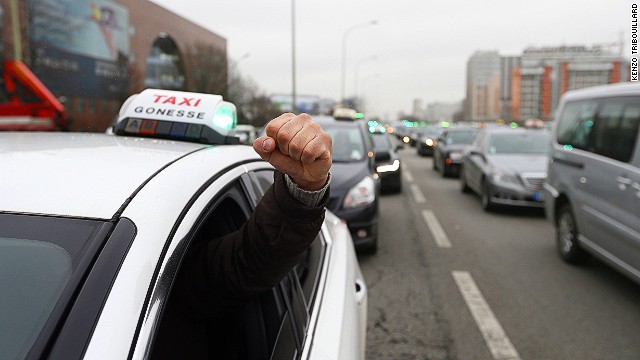
Victorious cab driver is victorious (or angry?). | Source: CNN
Since no one wants to be the DD, it looks like we've come back to cabs and their lacking usage in Grand Rapids. Excluding Ionia Avenue on the weekends, cabs are a rare sight. I imagine that trolling for fares in areas that have an attraction--e.g. Ionia and its many bars on the weekend--is the only legitimate way for a cabbie to get a decent night's pay. So, some people are definitely taking advantage of the cabs when they should be, but this is only a fraction of the market. Too many people are still getting behind the wheel for a number of reasons: they might think that a cab is too expensive or they could be too proud to admit that they are drunk. Get over it! The cost of a DUI in addition to the damage that could be done to a number of parties should be enough to convince both your wallet and your ego to think again about taxis.

If I want to get a taxi, I have to call one of the handful of companies in the city: Yellow Cab, Metro Cab, and Calder City Taxi are my usual choices. Just the other night, I had one of the best cab rides of my life; that's saying something, considering I've belted Celine Dion with my friends and a driver on one occasion. This recent driver though, he didn't sing. Instead, he said that McFadden's was terrible (he was preaching to the choir) and then we proceeded to talk about George Carlin, Noam Chomsky, linguistics, and Mensa--the world's oldest high IQ society. He was a funny man named Scott and he gave me his card. Looks like I'll be calling him whenever I need a ride now because he saved me and my friends from a drunken stumble home.